For international brands, Northern Europe can look deceptively simple on a map.
The Nordic and Baltic countries sit close together, many consumers are digitally connected, English proficiency is generally high, and technology products often arrive across several markets within a similar time frame.
It is easy, therefore, to think of the region as one audience.
From a media perspective, that assumption quickly breaks down.
A product launch that attracts attention in Sweden may need a different angle in Lithuania. A story that works for Finnish readers may require different context in Estonia. Pricing, availability, competitors, consumer habits and even the way a headline is written can change from one country to another.
That leaves brands with a familiar problem: how do you communicate efficiently across several relatively small markets without treating them as if they were identical?
For Smarti Link, the answer begins with local media.
One region does not mean one audience
The phrase "Nordic and Baltic market" is useful in business presentations, but consumers do not experience the region that way.
They buy products in their own countries.
They compare local prices. They visit local retailers. They search in their own language. They follow media brands they recognize and evaluate products in the context of their own market.
A Finnish reader researching a new smartphone is not necessarily looking for exactly the same information as someone in Latvia.
The hardware may be identical.
The questions surrounding it may not be.
Is the product officially available? What does it cost locally? Which configuration is being sold? Which competing products are already established in that market? Are particular services or features supported?
Automotive journalism makes the differences even more obvious.
Climate, taxation, charging infrastructure, vehicle availability and consumer preferences can all influence the way the same car is discussed from one country to another.
This is why reaching several countries cannot simply mean distributing the same message more widely.
Reach and relevance are different things.
The global press release has limits
International brands have become extremely efficient at distributing information.
A product announcement can reach thousands of journalists within minutes. Press kits contain photographs, specifications, quotes, videos and carefully prepared descriptions of every new feature.
That system is useful.
It is also why so much technology and automotive coverage can look remarkably similar on launch day.
Journalists around the world may receive exactly the same information at exactly the same time.
For a brand, the press release solves the distribution problem.
It does not automatically solve the communication problem.
The question is no longer whether information can reach a country.
It is whether someone in that country has a reason to pay attention.
Local media can provide that missing layer.
Instead of simply repeating that a new product exists, a local publication can place it within the market where the reader might actually buy it.
That distinction becomes particularly valuable for companies entering new countries or trying to build recognition outside their strongest markets.
Local language still changes the relationship
English can travel remarkably far across the Nordic and Baltic region.
That does not make local-language journalism unnecessary.
There is a difference between being able to read something in English and choosing to consume everyday news, reviews and buying advice in English.
For many readers, local-language media remains the more natural environment for discovering products and understanding what they mean in practical terms.
Language also affects tone.
A headline cannot always be transferred directly between English, Finnish, Lithuanian, Swedish, Danish, Latvian or Estonian without sounding unnatural.
Neither can every marketing expression.
Something that feels energetic in an English press release can become exaggerated after literal translation. Technical terms may be handled differently from one language to another. Sentence structures that work perfectly in English may feel heavy when reproduced too closely elsewhere.
Effective localization therefore requires more than linguistic accuracy.
It requires editorial judgment.
The goal should not be to make a text technically understandable.
It should be to make it feel as though it belongs in the publication where the reader finds it.
Local media is particularly important when the brand is not local
The strongest global brands have an obvious advantage.
Consumers already know their names.
When Samsung introduces a new Galaxy device or a major automotive manufacturer launches a new vehicle, the product itself carries enough recognition to generate attention.
Smaller and emerging brands face a different challenge.
A company may be well known in China, Germany or the United States but almost invisible to consumers in Estonia or Finland.
In those cases, simply announcing availability may not be enough.
Readers first need context.
Who is the company?
Why is the product interesting?
How does it compare with brands they already know?
Why should they trust it?
This is where original local coverage can do more than advertising alone.
A review, interview, hands-on report or editorial introduction allows readers to encounter the brand through an independent media environment rather than only through the company's own marketing.
For companies trying to enter several Northern European markets, that credibility can be difficult to build centrally.
Reviews turn a product into a story
Product reviews are one of the clearest examples.
Sending a press release tells journalists what a company wants to say about a product.
Sending the product allows journalists to find out what they want to say about it.
Those are fundamentally different forms of communication.
A meaningful review creates information that did not exist in the press kit.
How does the device feel after several days?
Does the battery perform as expected?
Are the cameras consistent?
Does the software make sense?
What compromises become visible only after regular use?
With vehicles, the difference is even greater.
Driving dynamics, comfort, visibility, software behavior, charging, cabin quality and everyday usability cannot be understood properly from a specification sheet.
That is why Smarti Link sees hands-on reviews as an increasingly important part of its Nordic and Baltic media strategy.
Our editorial work has already included products such as Samsung's Galaxy Z Fold 8 and vehicles including the XPENG P7+ and BYD Sealion 7.
The significance of those projects is not simply that another review exists online.
It is that original testing can form the basis for relevant local coverage across several markets.
One product, several local conversations
This is where a media network changes the equation.
Suppose a technology company provides one new smartphone for review.
Traditionally, that device might generate one article for one publication in one country.
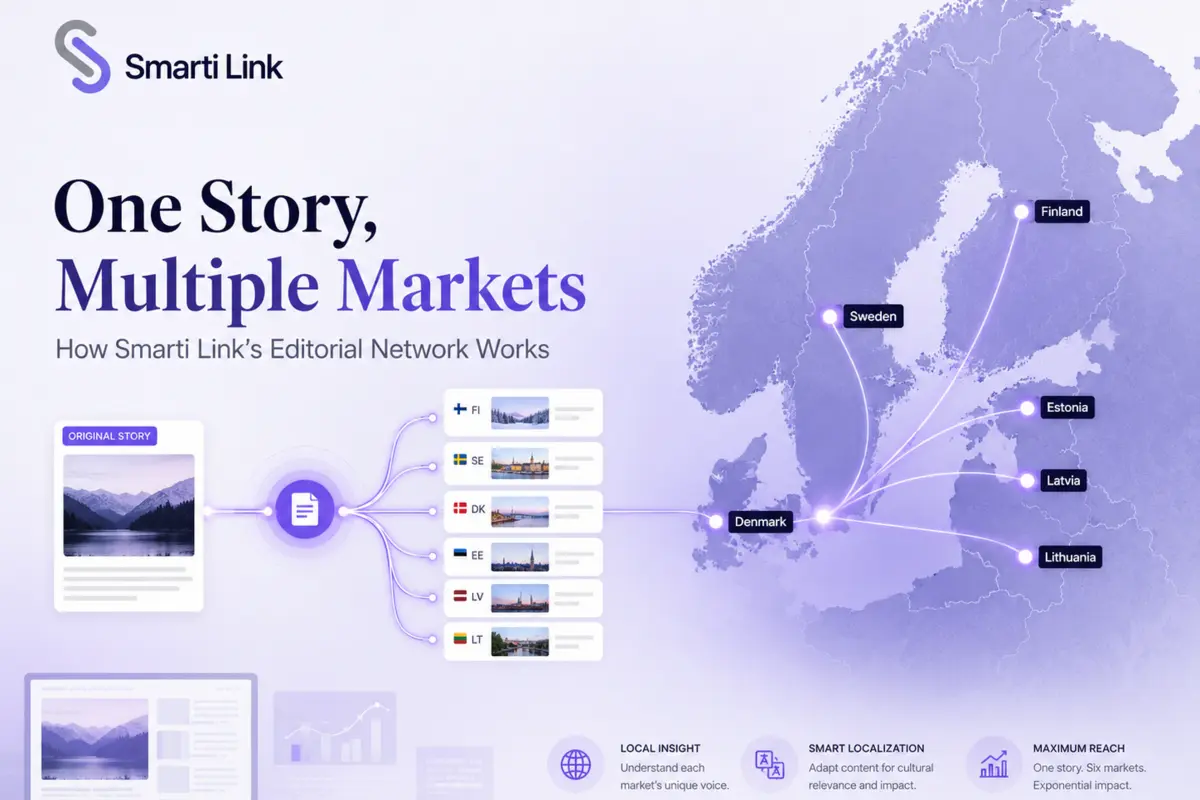
Within a multi-market editorial network, the same original testing can potentially support coverage across several local publications.
The phone is tested once.
Original photographs are produced once.
The editorial team identifies its strengths, weaknesses and important characteristics.
That reporting can then be adapted for relevant markets.
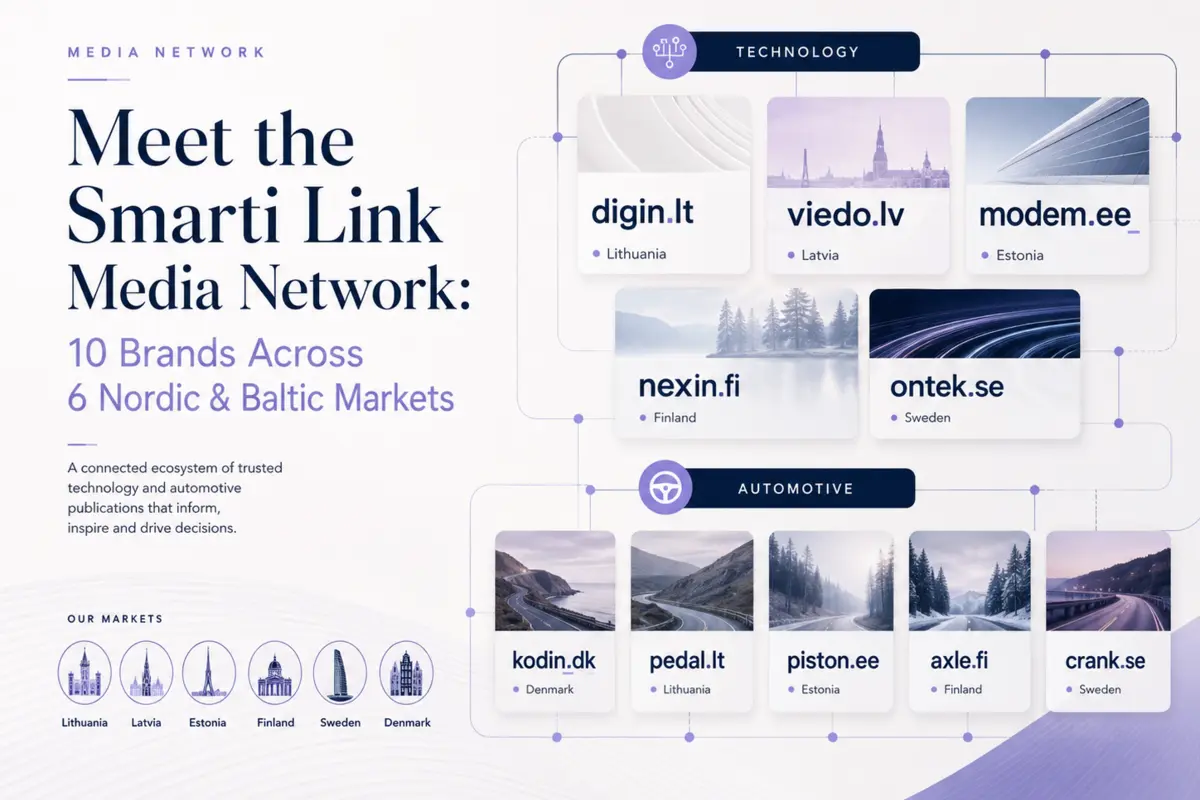
For Smarti Link's technology network, this can involve publications such as Digin.lt in Lithuania, Viedo.lv in Latvia, Modem.ee in Estonia, Nexin.fi in Finland, Ontek.se in Sweden and Kodin.dk in Denmark.
The underlying experience with the product is shared.
The final presentation does not need to be.
Local pricing can be added where appropriate. Market-specific context can change. Headlines can be written naturally for each language. The emphasis may shift depending on what matters to readers in that country.
The result is not six independent tests pretending to be unrelated.
Nor should it be one article copied six times.
It is one original editorial project given several local destinations.
Automotive brands face the same challenge
The model is equally relevant to automotive companies.
New manufacturers are entering Europe at a time when the industry is undergoing one of its biggest transformations in decades.
Electrification, software-defined vehicles, new battery technologies and the arrival of unfamiliar brands are changing both what consumers buy and what automotive journalists need to explain.
A manufacturer entering Finland, Sweden, Estonia or Lithuania cannot assume that awareness in one country automatically transfers to another.
A vehicle may need to be introduced repeatedly.
But the expensive part of automotive journalism, securing access to the car, driving it, photographing it and forming an informed opinion, does not necessarily need to be repeated from zero in every market.
Smarti Link's automotive network currently includes Pedal.lt in Lithuania, Piston.ee in Estonia, Axle.fi in Finland and Crank.se in Sweden.
When a vehicle is relevant across those markets, one original test can potentially support several localized editorial versions.
For brands, that creates efficiency.
For publications, it makes investment in original testing more sustainable.
For readers, the important point remains that someone actually drove the car.
Interviews can travel too
Physical products are not the only type of story that benefits from multi-market publishing.
An interview with an executive can have regional relevance even when the conversation takes place only once.
Imagine a CEO explaining a company's plans for expansion across Northern Europe.
A Finnish publication may focus on what the strategy means for Finland.
An Estonian article may highlight expansion into the Baltics.
Swedish readers may be more interested in product availability or partnerships in their own market.
The source interview remains the same.
What changes is editorial selection.
For PR teams, this can be particularly useful because executive time is often limited.
One meaningful interview can have greater regional value when the resulting material is handled by several relevant local publications.
Again, the benefit does not come from duplicating the same article everywhere.
It comes from making one source of original information useful to more than one audience.
Events create opportunities beyond the host city
The same principle applies to event coverage.
Trade shows, startup conferences, product launches and industry gatherings may take place in one city, but the stories emerging from them rarely belong only to that city.
A journalist attending an event can return with product hands-ons, interviews, photographs, company profiles and industry observations.
Smarti Link has already covered business, startup and technology events in Lithuania, including Startup Fair and TechFusion, alongside other industry gatherings.
As our event coverage expands internationally, the location of the event becomes less important than the relevance of the stories found there.
A product discovered in Berlin might interest readers in Helsinki.
An interview recorded in Lisbon could become relevant in Vilnius.
A company encountered at Slush may be entering several Nordic and Baltic markets at once.
For brands and event organizers, local media networks offer a way for that reporting to travel beyond the venue without losing its local context.
The best media outreach starts before the press release
There is another practical lesson for brands.
Good media coverage often begins earlier than companies expect.
PR teams sometimes contact publications only when the announcement is ready and the embargo expires the following morning.
At that point, the editorial possibilities are already limited.
The publication can report the news.
But deeper coverage usually requires more preparation.
Can the product be provided for testing?
Is an executive available for an interview?
Can journalists access the product before launch?
Are local prices confirmed?
Which markets will actually receive it?
Is there useful technical information beyond the marketing claims?
These questions determine whether a story becomes a short announcement or something more substantial.
For a multi-market network, early communication is even more useful because it allows editors to identify where a story genuinely belongs.
Not every product needs coverage in every country.
That is not a weakness of the model.
It is part of responsible editorial selection.
More markets do not automatically mean better coverage
The temptation in regional campaigns is to maximize the number of publications.
If five markets are available, why not publish in five?
Because relevance should still come first.
A product may only be sold in two of them.
A company may have no local presence in another.
A highly specific business story may matter significantly in Estonia but have almost no consumer relevance in Denmark.
The objective should not be maximum distribution at any cost.
It should be appropriate distribution.
For Smarti Link, that means considering each editorial opportunity market by market.
Sometimes the right answer may be one publication.
Sometimes it may be four.
For major technology products with broad availability, it may make sense to use the entire technology network.
The network provides the capability.
Editorial relevance determines how it is used.
Paid visibility and editorial coverage are not the same thing
Brands also need to distinguish between two very different objectives.
One is editorial coverage.
The other is sponsored visibility.
Both can be legitimate parts of a communications strategy, but readers should not be asked to confuse them.
Editorial reviews, interviews and reporting depend on editorial decisions and cannot reasonably come with a guarantee of positive coverage.
Sponsored articles serve a different purpose and should be handled transparently as commercial content.
For media companies, maintaining that distinction becomes more important as commercial relationships grow.
A brand should be able to work with a publication commercially without assuming that it has purchased the publication's opinion.
That separation protects readers, journalists and ultimately the credibility that makes media coverage valuable to the brand in the first place.
A regional strategy needs local execution
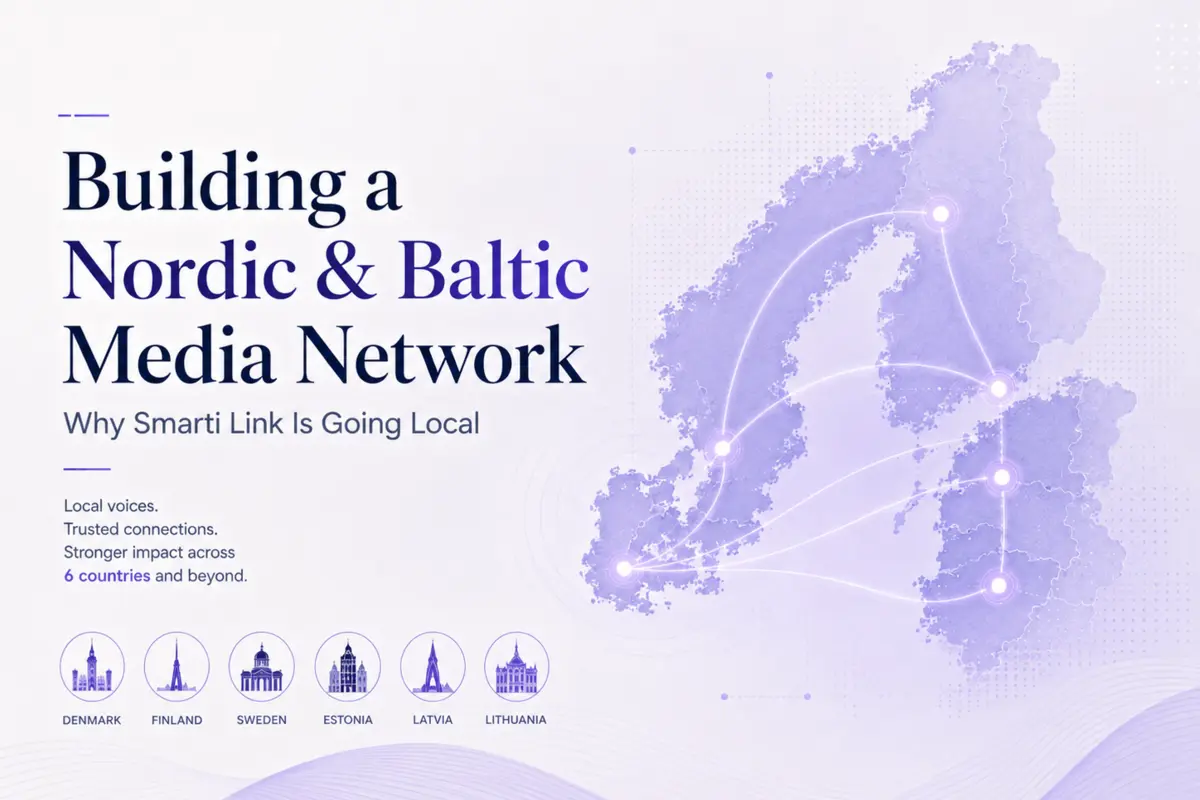
The Nordic and Baltic countries make sense as a strategic region.
Companies frequently plan them together. PR agencies coordinate multiple markets. Product launches may happen across several countries simultaneously.
But regional strategy works best when local execution remains visible.
That is the balance Smarti Link is trying to build.
One network can simplify access.
Shared reporting can reduce duplication.
Common editorial infrastructure can make original journalism more scalable.
But Digin should still speak to Lithuanian readers.
Nexin should make sense in Finland.
Ontek should feel Swedish.
Axle should understand the Finnish automotive market.
Connecting those publications should make them more capable, not less local.
What brands should bring to the conversation
For companies interested in reaching Nordic and Baltic audiences through local media, the most useful starting point is often not a finished press release.
It is clarity.
Which markets matter?
Where is the product available?
What is genuinely new?
Can the product be tested?
Is someone worth interviewing?
What information exists that readers cannot find simply by visiting the company's product page?
The stronger the material, the stronger the potential journalism.
That relationship is easy to overlook in an age of automated distribution and enormous press databases.
Sending information to more addresses has never been easier.
Creating something worth writing about remains much harder.
Local reach begins with a worthwhile story
There is no shortage of ways for brands to buy impressions across Europe.
Advertising platforms can target countries, languages, cities and audiences with remarkable precision.
Journalism serves a different function.
A good local media story does not simply place a product in front of someone.
It gives the reader a reason to understand it.
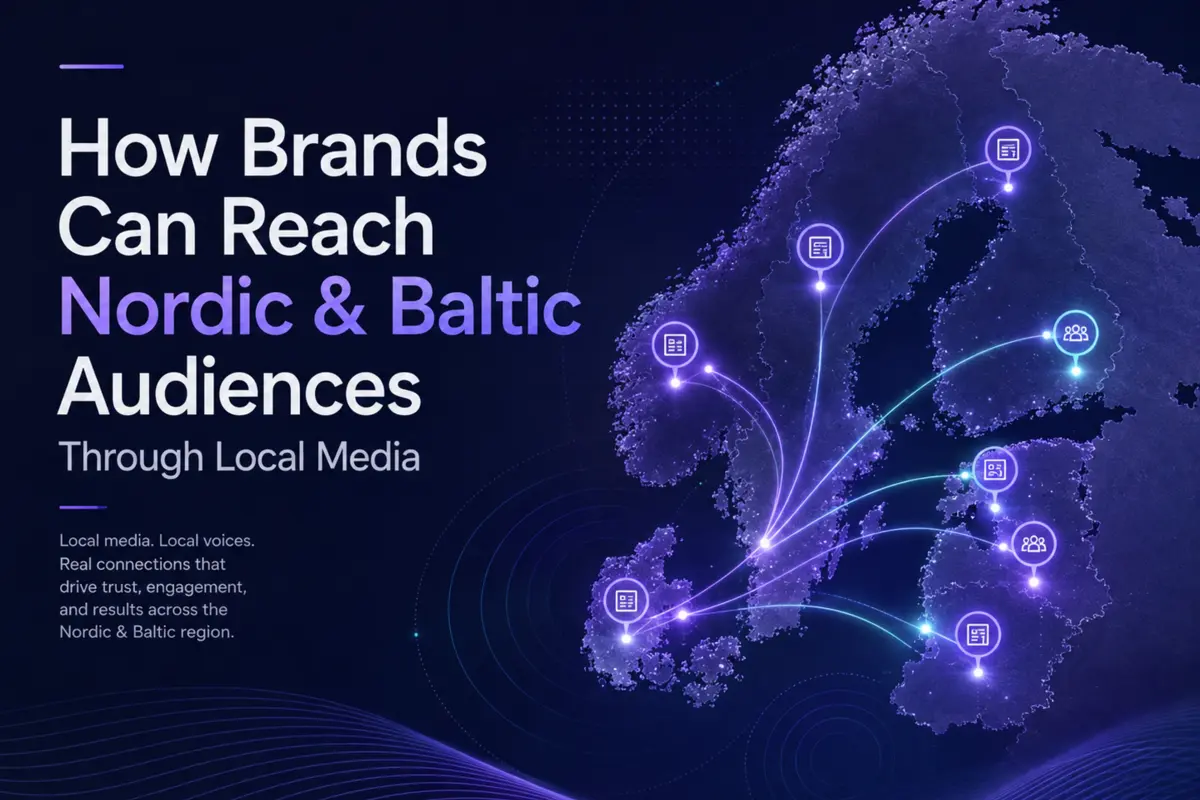
For brands entering the Nordic and Baltic region, that distinction matters.
Six countries do not require six completely disconnected communication strategies.
But neither should they be treated as one audience simply because they share part of a map.
The opportunity lies somewhere between those extremes.
Create something worth reporting.
Give journalists meaningful access.
Then allow the story to become local wherever it deserves to travel.
That is where a regional media network becomes useful, and where local media can turn one brand message into several genuine conversations.