A journalist walks into a technology event, spends an hour with a new device, speaks to the people who built it, takes photographs, asks questions that were not answered on stage and eventually leaves with enough material for a story.
Traditionally, that story would have one destination: the publication the journalist works for.
At Smarti Link, we are building a different model.
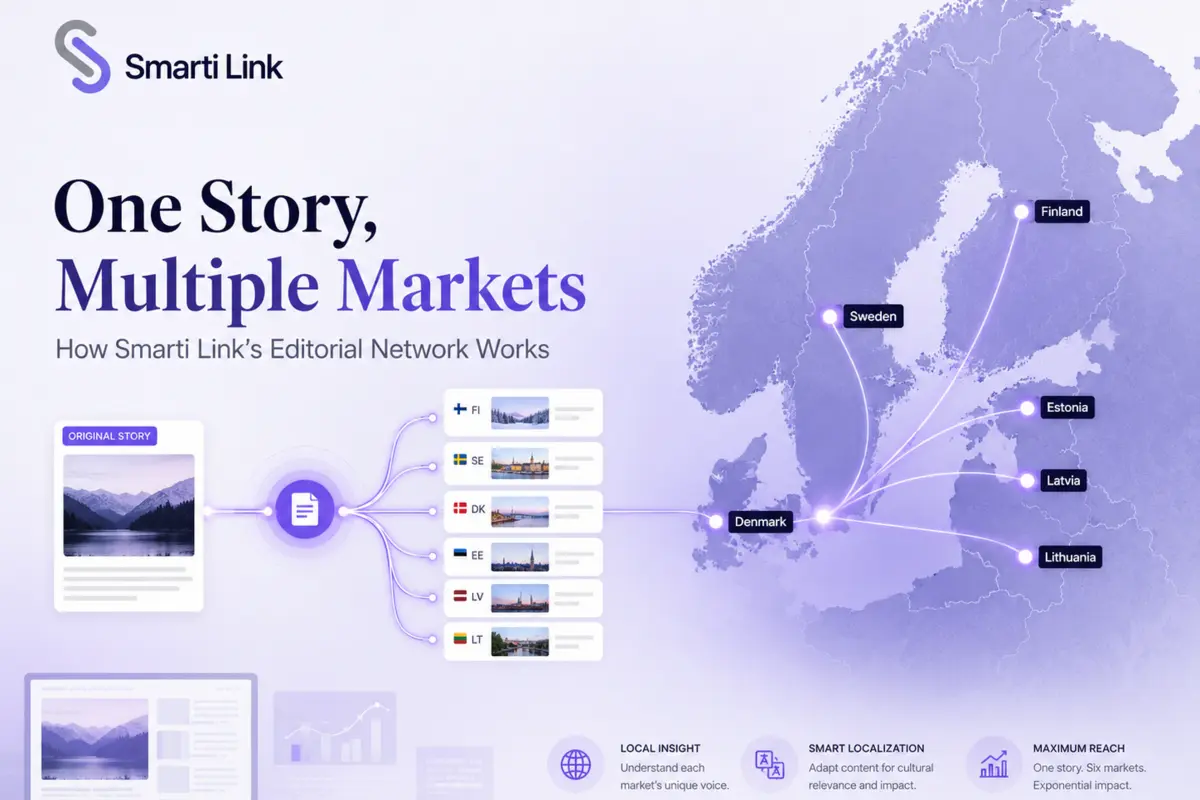
The reporting still begins with one journalist, one product, one interview or one event. But the finished work can reach readers across several Nordic and Baltic markets through a network of specialized local publications.
That is the idea behind a phrase we use often at Smarti Link:
One Story. Multiple Markets.
It sounds simple. In practice, making it work without turning journalism into mass-produced content requires considerably more than translation.
The reporting comes first
The easiest way to misunderstand a multi-market media network is to imagine one article being written, translated several times and automatically pushed to different websites.
That is not the model we are trying to build.
Everything starts with the source material.
Sometimes that source is a product in our hands. Sometimes it is a car we have driven. It can be an interview recorded at an event, a press briefing, a conversation with a founder or hours spent walking through an exhibition looking for products and companies worth covering.
The first job is therefore the same as it has always been in journalism: find something worth reporting and understand it well enough to tell the story.
No distribution system can compensate for weak source material.
If we review a smartphone, the value comes from actually using it, examining its strengths and weaknesses, photographing it and forming an editorial judgment.
If we cover an event, the useful part is being there: seeing what is happening outside the press releases, speaking to people and identifying stories that might otherwise disappear among hundreds of announcements.
The network comes afterwards.
One editorial asset can travel further
Consider a hands-on smartphone review.
Testing the device can take days. Photography takes additional time. Battery behavior, cameras, software, display quality, design and everyday usability all have to be considered before a meaningful conclusion can be reached.
Producing that work exclusively for one small market can make original journalism difficult to scale.
But the underlying reporting is not inherently Lithuanian, Finnish or Swedish.
A phone behaves the same way in Vilnius as it does in Helsinki. The photographs remain original. The strengths and weaknesses discovered during testing do not change at the border.
What does change is the reader.
A Lithuanian version of the review belongs on Digin.lt. A Finnish reader can encounter the same original testing through Nexin.fi. Swedish readers may see it through Ontek.se, while the same editorial project can also provide the basis for coverage on Viedo.lv, Modem.ee or Kodin.dk when the product and market are relevant.
The expensive part of the process, obtaining access, testing, reporting, photography and forming an editorial conclusion, has been performed once.
The journalism can then be adapted for several audiences.
That distinction is central to how Smarti Link works.
Ten brands, not ten copies
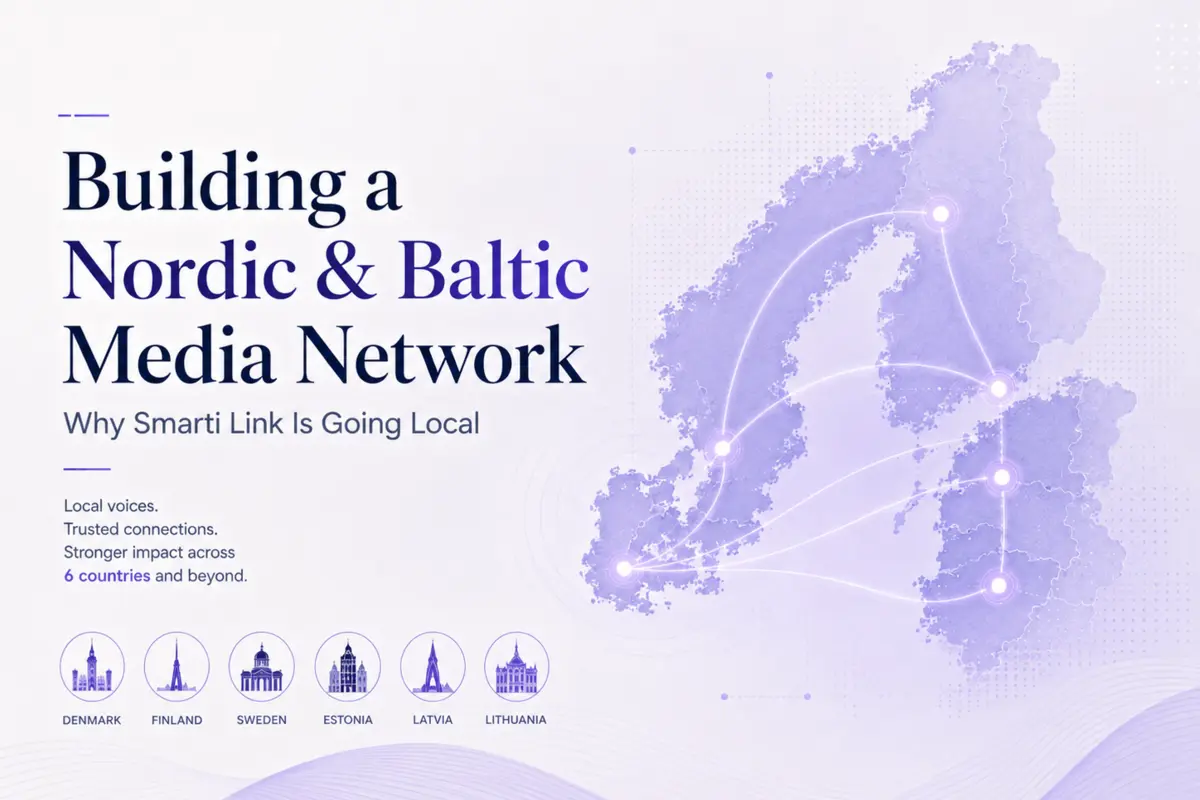
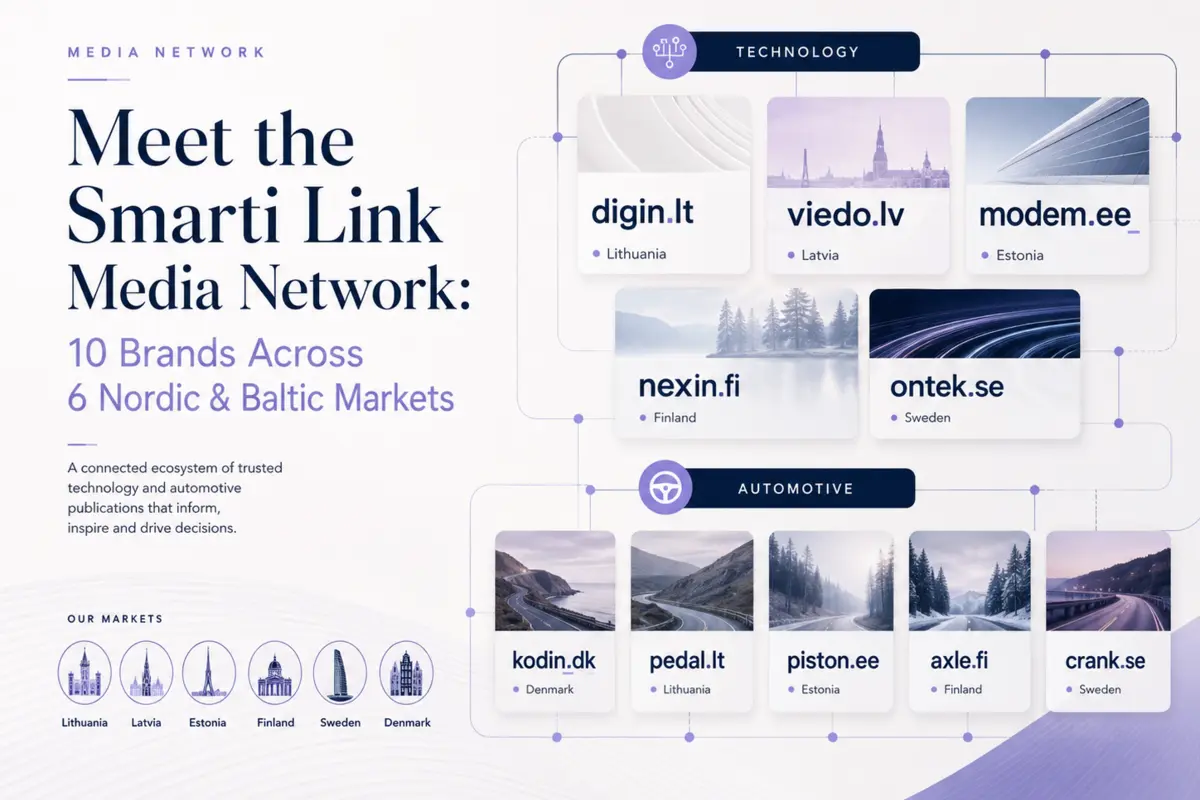
Smarti Link currently operates a network of ten specialized technology and automotive media brands across six Nordic and Baltic markets.
Our technology publications include Digin.lt in Lithuania, Viedo.lv in Latvia, Modem.ee in Estonia, Nexin.fi in Finland, Ontek.se in Sweden and Kodin.dk in Denmark.
The automotive side of the network currently includes Pedal.lt in Lithuania, Piston.ee in Estonia, Axle.fi in Finland and Crank.se in Sweden.
From an infrastructure perspective, connecting these publications creates obvious efficiencies.
Editorially, however, they cannot simply become mirrors of one another.
A media brand has to make sense to its own audience.
Readers do not visit a Finnish technology publication because they want to feel as though they are reading a translated version of a foreign website. They visit because they expect information to be understandable, relevant and presented naturally in their own market.
That is why the network model depends on a balance between shared reporting and local presentation.
Centralization makes the reporting more scalable.
Localization keeps the publications useful.
Translation is only the beginning
There is a major difference between translating an article and publishing it properly for another market.
Literal translation can preserve information while destroying tone.
Headlines are one obvious example. A headline that feels natural in English can sound strangely formal, exaggerated or simply awkward when carried directly into another language.
The same is true of product terminology, prices, availability and references to local services.
Even reader expectations can differ.
A vehicle story written for Finland may deserve more attention to winter performance or charging conditions. A consumer electronics story may need different pricing information depending on where the product is officially available. A service that is commonplace in one Nordic country might barely exist in another.
Not every story needs extensive local modification, but the decision itself is editorial.
The goal is not to make six articles artificially different.
It is to make each version feel as though it belongs where it has been published.
A shared editorial core
Behind the individual publications is a common editorial process.
That process allows source material to move through the network without losing track of where it came from.
A typical original story may pass through several stages:
Reporting and research.
The original information is gathered, whether through hands-on testing, an interview, event attendance, research or direct communication with a company.
Primary editorial production.
The central story is written around the facts, observations and material collected during reporting.
Market selection.
Not every article automatically belongs everywhere. The team determines which publications and audiences are actually relevant.
Localization and adaptation.
The story is prepared for the language, context and editorial style of each selected market.
Publication and presentation.
Headlines, imagery, categorization, internal links and other publication-level details are handled for the individual media brand.
The process is designed to make distribution efficient without treating distribution itself as journalism.
That difference matters to us.
Publishing more versions of a weak story does not make it stronger.
Reviews show the model at its best
Original reviews are perhaps the clearest example of why a shared editorial network makes sense.
Smarti Link has been developing hands-on coverage across both of its core verticals.
On the technology side, that includes products such as Samsung's Galaxy Z Fold 8. In automotive media, our editorial work has included vehicles such as the XPENG P7+ and BYD Sealion 7.
These are resource-intensive projects.
A meaningful vehicle review requires access to the car, time behind the wheel, photography and enough experience with the vehicle to move beyond the specification sheet.
A smartphone review has the same underlying problem. There is little value in calling something a review if the article consists primarily of manufacturer claims rewritten into paragraphs.
When the underlying testing is original, however, a media network changes the economics of producing that work.
One properly conducted review can support several high-quality local editions.
That gives us a stronger reason to invest time in original testing instead of relying entirely on the same launch material available to everyone else.
It also creates an interesting proposition for manufacturers.
A review unit supplied to one editorial network can potentially reach relevant audiences across several local markets, without requiring the brand to coordinate separately with a long list of unrelated publications.
Editorial independence remains separate from that logistical advantage. Access to a product provides an opportunity to review it, not a guarantee of a positive conclusion.
Events create the same opportunity in real time
The model becomes even more visible during event coverage.
A major exhibition can generate hundreds of announcements in a single day. Most journalists cannot cover all of them, and most readers would not want them to.
The job is to identify what matters.
Smarti Link's event work has already included coverage from technology, startup and business events in Lithuania. As the network develops, the same approach can extend naturally to major international gatherings across Europe and beyond.
A single event can generate several types of original material:
news reports, executive interviews, product hands-ons, photography, company profiles, analysis and broader reports about emerging trends.
Some of those stories may matter across every technology publication in the network.
Others may only make sense for one or two markets.
That flexibility is important.
Multi-market publishing should increase the potential reach of journalism, not create an obligation to publish everything everywhere.
The same interview can tell different stories
Interviews are another example.
Imagine speaking with the CEO of a technology company expanding into Northern Europe.
The core conversation happens once.
But the resulting story might have different points of emphasis depending on the publication.
Readers in Lithuania may be interested in whether the company plans to enter the Baltic market. Finnish readers may care more about regional partnerships or product availability. A Danish technology publication might highlight another part of the same conversation.
The source remains identical.
The journalism changes through selection and context.
This is one of the reasons we see localization as an editorial process rather than a purely linguistic one.
Technology helps, but it is not the story
Modern publishing infrastructure makes a network like Smarti Link possible at a scale that would have been far more difficult a decade ago.
Content management systems can connect publications. Automation can remove repetitive technical work. Language technology can accelerate parts of the localization process. Shared workflows can reduce the amount of time spent moving photographs, metadata and drafts between teams.
We use technology because it allows journalists and editors to spend less time on repetitive publishing tasks.
But technology is infrastructure, not the editorial proposition.
Readers do not care how efficiently an article moved through a content management system.
They care whether the article tells them something useful.
That is why our public focus remains on the journalism itself: reviews, reporting, interviews, events and useful coverage of technology and automotive industries.
The machinery behind it should largely remain invisible.
Not every story needs six versions
Scale creates another temptation: if something can be published everywhere, why not publish it everywhere?
Because relevance still matters.
A company entering Estonia may deserve coverage on Modem.ee but have little immediate relevance to readers in Sweden.
A vehicle may be available in Finland and Lithuania but not Denmark.
A local startup event can generate one story with genuine regional importance and another that matters primarily to the market where the event took place.
Our objective is not maximum duplication.
It is useful distribution.
This makes editorial selection more important as the network grows, not less.
The question is not simply, "Where can we publish this?"
It is, "Where should this story be published?"
Scale without becoming generic
There is an inherent tension in building any media network.
Scale rewards standardization.
Journalism rewards specificity.
Push too far toward standardization and every publication starts sounding the same. Push too far in the other direction and the efficiencies of operating a network disappear.
Smarti Link sits deliberately between those two extremes.
We want shared technology, shared reporting capabilities and a common editorial foundation.
At the same time, we want Digin to remain Digin, Nexin to remain Nexin and Axle to remain Axle.
The brands should become stronger because they belong to a network, not disappear inside it.
That will take time, particularly as some of our markets and publications are still at different stages of development.
But it is also what makes the project interesting.
What this means for brands and PR teams
For companies operating across Northern Europe, media outreach is often fragmented.
A product launch may require separate communication with publications in Finland, Sweden, Denmark and the Baltic states. Review samples need to be coordinated. Press information is distributed repeatedly. Different markets move at different speeds.
A network such as Smarti Link cannot eliminate those differences, nor should it.
What it can do is create a single point of contact for editorial opportunities that may have relevance across several markets.
A technology company can introduce one product to our network.
An automotive brand can discuss access to a new vehicle.
An event organizer can invite one editorial team knowing that the resulting reporting may have a route to several local publications.
From there, we decide where the story belongs and how it should be handled editorially.
For the company, that can simplify communication.
For us, it can improve access to original material.
For readers, the result should simply be better coverage.
That final part is the test that matters.
One story is only the starting point
"One Story. Multiple Markets." is easy to interpret as a distribution slogan.
For us, it means something slightly different.
The "one story" represents the part of journalism that is difficult to reproduce: access, observation, reporting, testing, photography, interviews and editorial judgment.
"Multiple markets" represents the opportunity to make that work useful to more readers.
The network exists to connect those two things.
As Smarti Link develops across the Nordic and Baltic region, the challenge will not simply be to publish more.
It will be to make original journalism travel further without making it feel less local.
If we can do that consistently, one story really can belong in more than one market.