A media network can be measured in websites, domains or monthly page views. But those numbers say relatively little about what the network is actually trying to become.
For Smarti Link, the more useful number right now is ten.
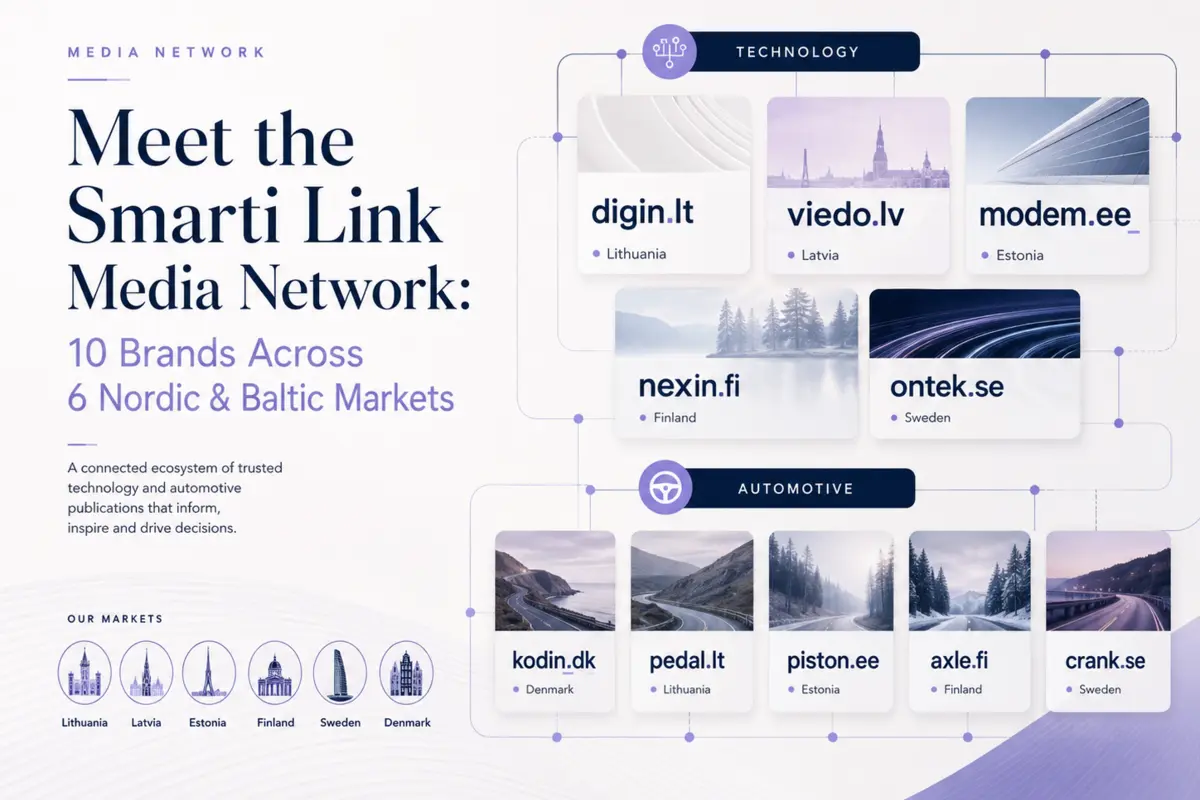
Ten specialized media brands, operating across six Nordic and Baltic markets, with a clear focus on two industries that increasingly overlap: technology and automotive.
From Digin.lt in Lithuania to Kodin.dk in Denmark, and from Finland's Axle.fi to Sweden's Crank.se, the network has been built around a simple idea: local media brands can remain distinct while benefiting from shared reporting, technology and editorial resources.
That matters because Smarti Link is not intended to become one large regional publication translated into several languages.
We are building something more distributed.
Six markets. Ten publications. Local identities connected by one editorial network.
Why ten separate media brands?
Creating one English-language website for Northern Europe would certainly be easier.
There would be one homepage to manage, one editorial identity to establish and one publication to promote.
But it would also solve a different problem.
People may follow international technology publications and global automotive websites, but local-language media continues to serve a purpose that global outlets cannot always replicate.
A reader considering a smartphone in Finland may care about local pricing, availability and services. Someone researching an electric vehicle in Lithuania may be looking at a completely different market environment. A Swedish reader and an Estonian reader can be interested in the same product without necessarily needing the same article presented in exactly the same way.
That is why Smarti Link has chosen to build individual brands rather than placing every market under a single regional publication.
The network provides the shared infrastructure.
The publication provides the local destination.
Six markets across the Nordic and Baltic region
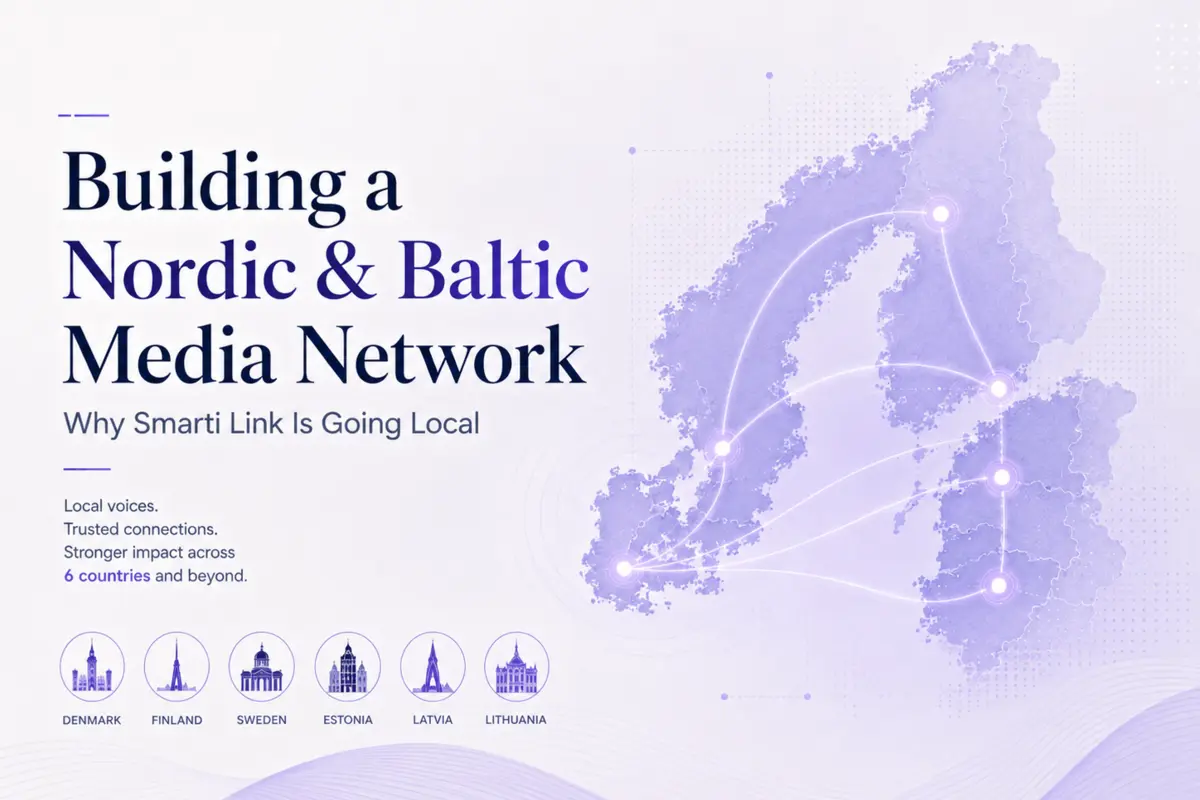
Smarti Link's current focus covers Lithuania, Latvia, Estonia, Finland, Sweden and Denmark.
Geographically, these countries sit close to one another.
Editorially, they should not be treated as one homogeneous audience.
They have different languages, market sizes, consumer habits, technology ecosystems and media traditions.
The challenge for us is therefore not to make six markets behave like one.
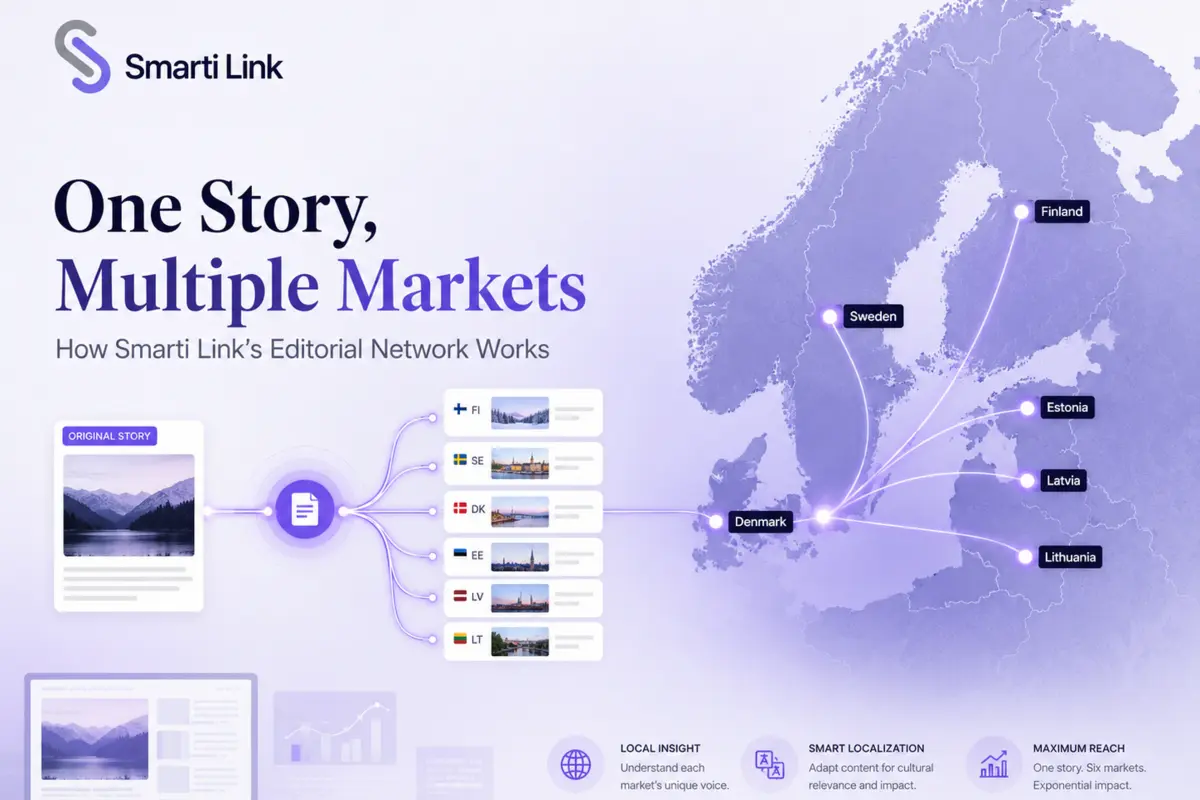
It is to build a system in which journalism created in one part of the network can travel across the region when it is relevant, while still making sense within each publication.
That is where the ten individual media brands come in.
Digin.lt: technology in Lithuania
Lithuania is where much of Smarti Link's media development began, and Digin.lt has become one of the central technology publications in the network.
Its editorial territory is broad enough to reflect the way technology is consumed today: smartphones, computers, artificial intelligence, consumer electronics, software and the wider technology industry.
It is also an important testing ground for the type of original coverage we want to produce more frequently across the network.
Hands-on product reviews, event reporting and original stories can begin with one publication such as Digin and later provide the editorial foundation for coverage elsewhere.
But Digin is not intended to function merely as the Lithuanian endpoint of a centralized content system.
It is a Lithuanian technology publication first.
That distinction applies to every brand in the network.
Viedo.lv: our technology publication in Latvia
Across the border in Latvia, Viedo.lv provides the technology side of Smarti Link's Latvian presence.
The name, publication and audience are separate, but the underlying editorial resources can be shared with the wider network.
If Smarti Link tests a major new smartphone, attends an international launch or interviews an executive whose comments are relevant across the region, Viedo can participate in that reporting without having to recreate the entire process independently.
The objective is efficiency without sameness.
A shared source does not require identical presentation.
This is one of the central principles behind the network and one that becomes increasingly important as the number of original stories grows.
Modem.ee: technology coverage for Estonia
Estonia occupies an interesting place in any conversation about technology in Northern Europe.
The country has built an international reputation around digital services, entrepreneurship and technology, making it a natural market for a specialized technology publication.
Modem.ee represents Smarti Link's technology vertical in Estonia.
Like the other publications in the network, its role extends beyond daily technology news.
The longer-term objective is to increase the proportion of content based on direct access: products we have tested, companies we have spoken with, events we have attended and developments that deserve more than a rewritten announcement.
That transition from volume toward stronger original editorial work is one of the broader goals across Smarti Link.
Nexin.fi: entering the Finnish technology market
Finland is one of the core Nordic markets in the network, represented in technology by Nexin.fi.
For Smarti Link, Finland is particularly important because the country's relationship with technology runs much deeper than consumer electronics alone.
It is a mature digital market with a strong engineering and startup culture, as well as a long history in telecommunications and technology development.
Our ambition for Nexin is therefore not simply to publish translated versions of international technology news.
The publication needs to gradually build its own relationship with Finnish readers, companies and the wider technology ecosystem.
That takes considerably longer than registering a domain or launching a website.
It requires consistent publishing, stronger local context, original reviews and eventually a recognizable editorial identity.
Networks can be built quickly.
Media brands cannot.
Ontek.se: building a technology presence in Sweden
Sweden adds another major Nordic market to the network through Ontek.se.
The same principle applies here: Smarti Link provides the infrastructure and shared editorial capabilities, while Ontek needs to work as a Swedish technology publication in its own right.
Sweden is also important from a commercial perspective.
Many global technology companies already treat the Nordic countries as an important regional market, meaning relationships with manufacturers, PR agencies and event organizers can potentially create opportunities across more than one Smarti Link publication.
A product introduced to our editorial team in Sweden may also be relevant in Finland, Denmark or the Baltic states.
That is where the network model becomes useful.
One relationship can create access.
One piece of original reporting can then serve several appropriate markets.
Kodin.dk: extending the network into Denmark
Kodin.dk is the newest geographical extension of Smarti Link's technology network, giving us a presence in Denmark and bringing the total number of current markets to six.
Denmark also completes an important part of our Nordic footprint alongside Finland and Sweden.
As with the rest of the network, the publication is not being built around the assumption that more websites automatically mean more value.
The real work begins after launch.
Kodin needs relevant content, consistent publishing and a reason for Danish readers to return.
Its presence also strengthens the network for companies looking at the region more broadly.
A technology company interested in reaching Northern European audiences can potentially work through one editorial relationship while appearing across several distinct local publications when the story justifies it.
That is much closer to the model Smarti Link is trying to establish.
Technology is only half of the network
Six of Smarti Link's ten current publications focus on technology.
The remaining four cover automotive.
At first glance, running technology and automotive publications under the same network might appear to be two separate businesses.
Increasingly, it is not.
Modern cars are filled with the same subjects technology journalists have covered for years: software, processors, cameras, displays, connectivity, artificial intelligence, batteries and operating systems.
Electric vehicles have accelerated that convergence.
A new car can now be evaluated partly as a mechanical product and partly as a piece of consumer technology.
For Smarti Link, having both verticals inside the same editorial network therefore creates natural overlap.
Pedal.lt: Smarti Link's Lithuanian automotive publication
Pedal.lt represents the automotive side of the network in Lithuania.
Its territory includes new vehicles, automotive industry developments, electric mobility and, importantly, original vehicle reviews.
Cars are one of the clearest examples of why direct access matters.
Specifications can be copied from a manufacturer's website. Press releases can describe acceleration, battery capacity and equipment.
But none of that tells the reader what a car actually feels like to use.
Original automotive journalism begins when someone gets behind the wheel.
That is why vehicle testing is becoming an increasingly important part of Smarti Link's editorial strategy.
When we have access to a new model, the resulting work can include driving impressions, photography, detailed observations and conclusions that can later support coverage in other relevant markets.
Piston.ee: automotive coverage in Estonia
Piston.ee extends the automotive network into Estonia.
It operates alongside Modem.ee, giving Smarti Link both technology and automotive publications in the country.
That two-publication structure is also present in several of our other markets.
There is a practical advantage to keeping the verticals separate.
Someone visiting Piston should know they have arrived at an automotive publication.
A reader on Modem should encounter a technology-focused environment.
The editorial infrastructure behind those sites can overlap considerably without forcing the reader-facing brands to do the same.
This approach allows specialization at the publication level while maintaining efficiency at the network level.
Axle.fi: automotive journalism for Finland
Axle.fi is Smarti Link's automotive publication for Finland.
The Finnish automotive market is particularly interesting for coverage involving electrification, changing vehicle technology and the practical realities of driving in northern conditions.
It is also a market where localized automotive journalism can add context that a global vehicle review may not provide.
A car tested elsewhere remains fundamentally the same vehicle, but the questions surrounding ownership can change significantly between countries.
Climate, charging infrastructure, taxation, pricing and availability all influence what readers need from a review.
That is precisely why our network model relies on adaptation rather than simple replication.
The original test can be shared.
The final editorial product still needs to understand where it is being read.
Crank.se: automotive coverage in Sweden
Sweden's automotive publication within the network is Crank.se.
The country is an obvious market for serious automotive coverage, particularly as traditional car manufacturing and the transition toward electric mobility increasingly intersect.
For Smarti Link, Crank also gives automotive projects a second significant Nordic destination alongside Axle.
A vehicle test conducted by our team may therefore begin as one editorial project but eventually reach readers in Sweden, Finland, Lithuania and Estonia through four separate automotive publications.
Not every car will be relevant in every country.
Not every article needs four versions.
But when the relevance is there, the infrastructure already exists.
Ten brands, two verticals, one editorial network
Placed together, the network currently looks like this:
Technology
Lithuania: Digin.lt
Latvia: Viedo.lv
Estonia: Modem.ee
Finland: Nexin.fi
Sweden: Ontek.se
Denmark: Kodin.dk
Automotive
Lithuania: Pedal.lt
Estonia: Piston.ee
Finland: Axle.fi
Sweden: Crank.se
The numbers are simple:
10 media brands.
6 markets.
2 editorial verticals.
But the number of publications is not the point by itself.
The important part is what becomes possible when those publications can work together.
What happens when the network covers one product?
Imagine Smarti Link receives access to a new flagship smartphone.
The process may begin with several days of testing.
Our editorial team examines the cameras, display, battery, software, performance and design. Original photographs are produced. Weaknesses are identified. The manufacturer's claims are compared with real-world experience.
At that point, we have something much more valuable than a press release.
We have an original editorial asset.
If the device is relevant across the region, that work can become coverage for Digin, Viedo, Modem, Nexin, Ontek and Kodin.
The six resulting articles do not need to be identical.
Local prices may differ.
Availability may differ.
The way a headline is written may differ.
Context may differ.
But the difficult part of journalism, actually spending time with the product and forming an independent view of it, has already taken place.
One review can therefore become six useful local publications without requiring six separate review processes.
The same logic applies to cars
Now replace the smartphone with a vehicle.
Smarti Link has already worked with vehicles including the XPENG P7+ and BYD Sealion 7 as part of our developing original automotive coverage.
Vehicle testing requires significant resources.
Access has to be arranged. Someone needs to drive the car. Photographs have to be produced. The vehicle's strengths and weaknesses need to be understood well enough to make a meaningful judgment.
Once that work exists, there is no obvious reason it should automatically belong to only one country.
If the model is available and relevant across several markets, Pedal, Piston, Axle and Crank can each give the original testing a local destination.
Again, the network amplifies the reporting rather than replacing it.
Events can produce an entire editorial package
The same concept becomes even more powerful at events.
A journalist attending a major exhibition does not necessarily return with one story.
An event can produce dozens.
There may be product launches, executive interviews, startup discoveries, hands-on demonstrations, photography and broader industry trends worth reporting.
Smarti Link has already covered events ranging from Startup Fair and TechFusion to investor and accelerator gatherings in Lithuania.
Our goal is to expand that type of reporting to major technology and industry events elsewhere in Europe as the network develops.
When we attend an event, the value is not simply that "Smarti Link was there."
The value is what comes back with us.
An interview can become relevant across several publications.
A product launch can be localized for multiple markets.
A set of original photographs can accompany reporting throughout the network.
One trip can therefore generate an editorial package far larger than a single event recap.
Why brands may care about the structure
The network also changes how companies can interact with Smarti Link.
A technology manufacturer launching a product across Northern Europe normally has to think market by market.
Different publications. Different journalists. Different languages. Different contacts.
Those differences do not disappear when working with Smarti Link, because the publications themselves remain local.
But access can become simpler.
A company can introduce a product or story to one network.
From there, our editorial team can determine where the subject is relevant and which publications should cover it.
That could mean one market.
It could mean three.
Occasionally, it could mean all six.
For PR teams, that can create a much more efficient relationship than approaching every publication independently.
For Smarti Link, it creates better opportunities to secure direct access to products, executives and events.
And that access ultimately benefits the journalism.
The harder part begins now
Building ten websites is measurable.
Building ten media brands is not nearly as simple.
A domain can exist without an audience.
A publication can publish hundreds of articles without developing a recognizable identity.
Traffic can increase without necessarily producing trust.
We are aware of that distinction.
Smarti Link's next stage therefore involves less emphasis on adding websites simply for the sake of increasing the size of the network and more emphasis on strengthening the publications already inside it.
That means more original reviews.
More direct reporting.
More interviews.
More event coverage.
Better relationships with the technology and automotive industries.
And stronger connections between the publications without erasing what makes each of them local.
A network is only valuable if the publications are valuable
There is always a danger when talking about media networks that the discussion becomes dominated by scale.
More markets.
More domains.
More languages.
More articles.
Those numbers are useful, but they are not enough.
The long-term value of Smarti Link will depend on whether readers see Digin, Nexin, Pedal, Axle and the rest of the network as publications worth visiting.
That is a slower process than building technical infrastructure.
It is also a more important one.
Our ten publications are currently at different stages of that journey. Some markets are more developed than others. Some brands have longer histories. Others are still establishing their place.
We do not see that as something to hide.
We see it as the work ahead.
Local brands, regional potential
Smarti Link began with individual digital publishing projects.
What is emerging now is a more focused regional media company.
Technology and automotive.
Nordics and Baltics.
Ten publications connected through common editorial capabilities while remaining separate enough to serve their own audiences.
The network will continue to evolve, and its composition may grow with it.
But the principle is unlikely to change.
We do not want to replace local media identities with one regional publication.
We want to make those local publications stronger by connecting them.
That is what the ten brands inside Smarti Link represent today.
And ultimately, the success of the network will not be measured by how many websites we can put on a map.
It will be measured by how much worthwhile journalism we can produce through them.