Digital media has never been more global. A product launched in Seoul can become a headline in Helsinki within minutes, a new electric car unveiled in Munich can be discussed across Europe before the press conference is over, and major technology events increasingly speak to audiences far beyond the cities in which they take place.
Yet the way people consume those stories remains surprisingly local.
Readers still want technology explained in their own language. They want to know whether a new smartphone makes sense in their market, what a new electric vehicle means for local buyers, and why an international industry development matters where they live.
That idea is at the heart of what we are building at Smarti Link.
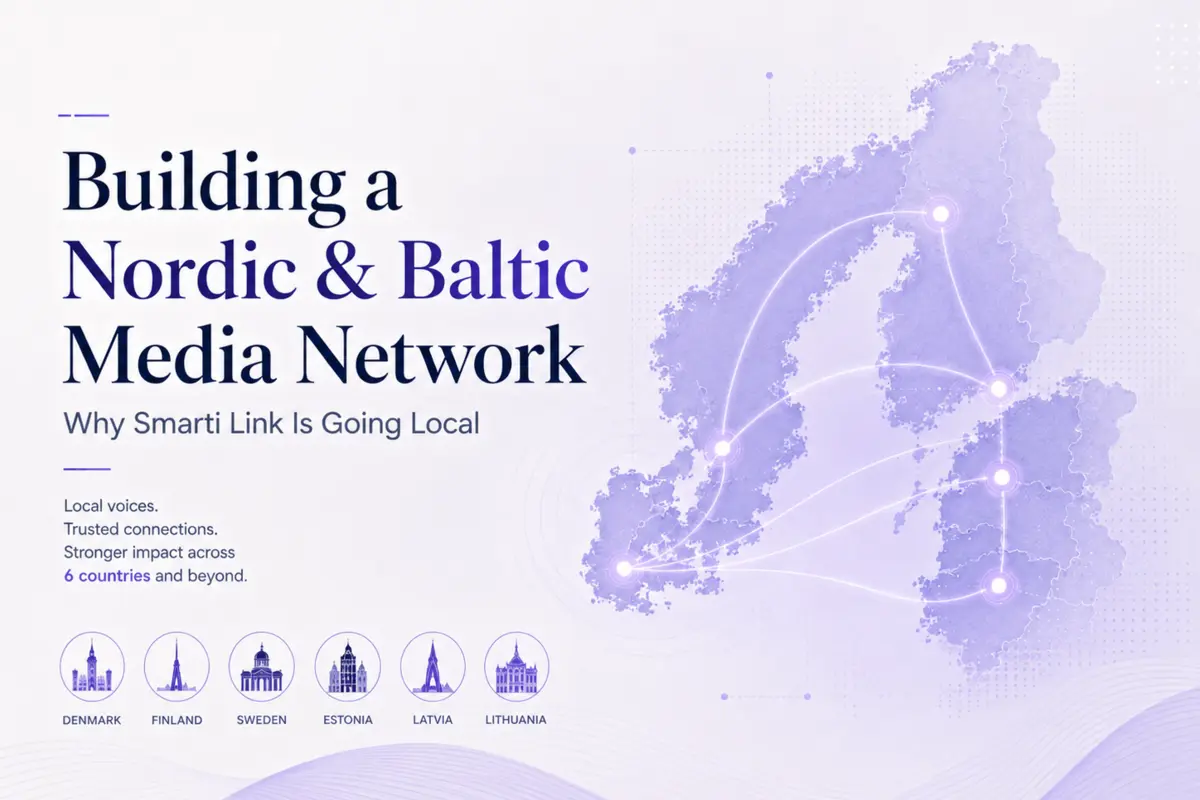
Rather than trying to become another broad European publication, Smarti Link is developing a network of specialized technology and automotive media brands focused specifically on the Nordic and Baltic region.
It is a smaller geographical focus, but a much more ambitious editorial one.
A network built around local media
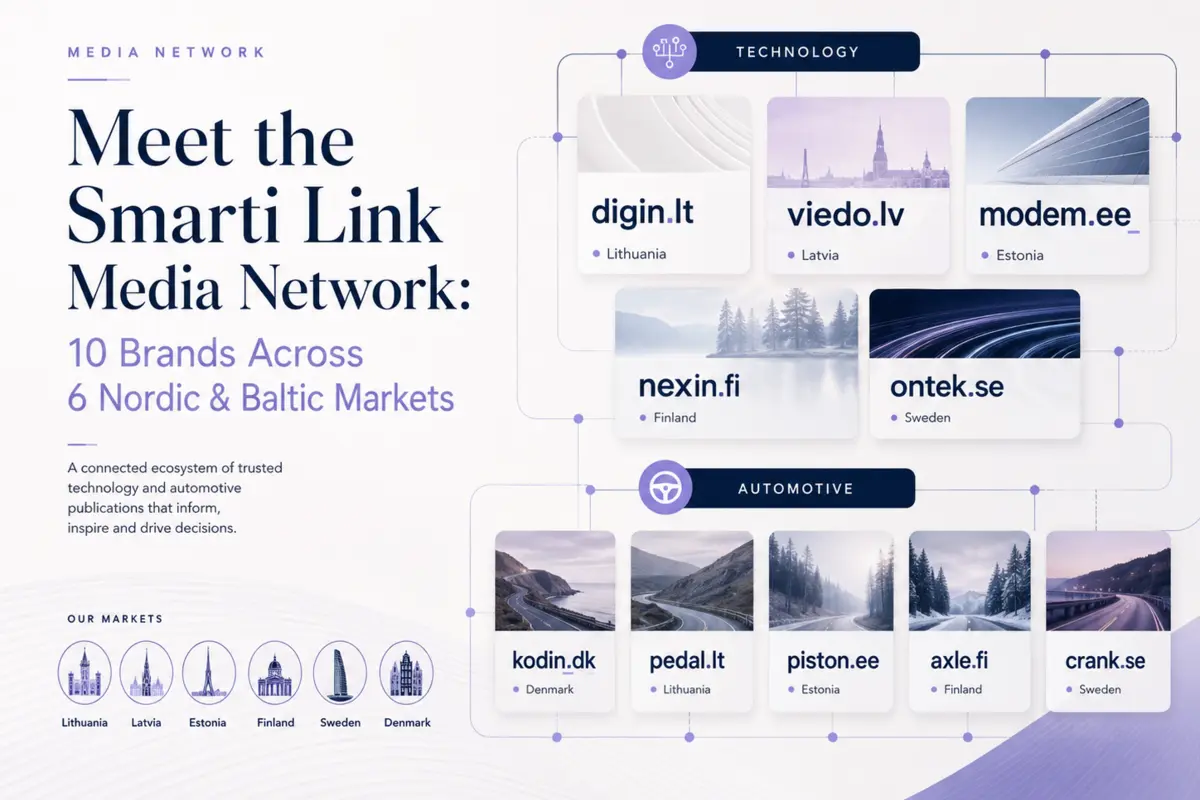
Smarti Link currently brings together ten specialized publications operating across Lithuania, Latvia, Estonia, Finland, Sweden and Denmark.
Our technology network includes:
- Digin.lt in Lithuania
- Viedo.lv in Latvia
- Modem.ee in Estonia
- Nexin.fi in Finland
- Ontek.se in Sweden
- Kodin.dk in Denmark
Our automotive network currently includes:
- Pedal.lt in Lithuania
- Piston.ee in Estonia
- Axle.fi in Finland
- Crank.se in Sweden
Each publication is intended to serve its own market and audience.
The goal is not to create ten identical websites with different domain names. It is to build recognizable local media brands that share editorial resources while maintaining a clear connection to their respective markets.
This distinction matters.
A Finnish reader visiting Nexin.fi should feel that they are reading a Finnish technology publication. Someone visiting Digin.lt should encounter a publication created with Lithuanian readers in mind. The same principle applies to automotive coverage across Pedal, Piston, Axle and Crank.
Smarti Link operates behind those brands as the network connecting them.
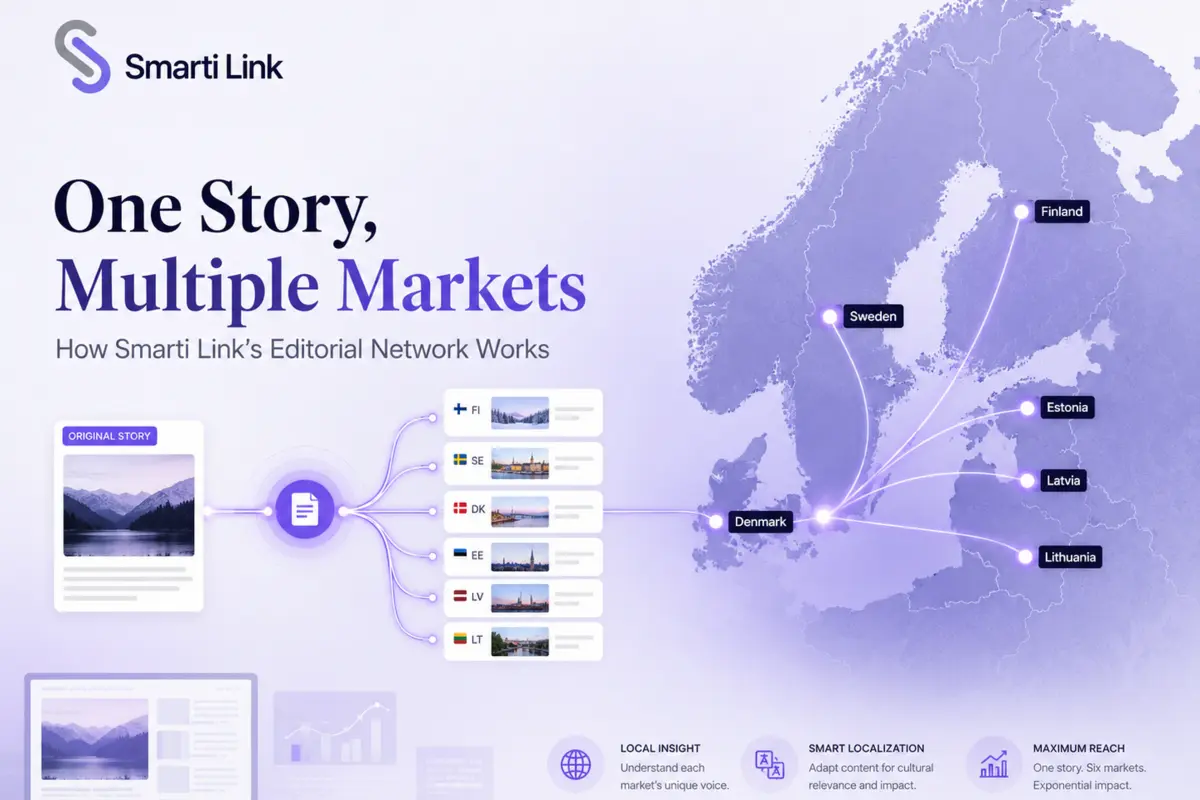
One story can have more than one home
The traditional model of local media creates a simple problem.
Good journalism takes time.
A journalist attending a major technology event may spend hours interviewing executives, testing products, taking photographs, gathering information and turning everything into a useful story. Traditionally, much of that work would serve the audience of a single publication.
Our model allows that original reporting to travel further.
Imagine our editorial team is attending a major international technology event.
A new smartphone is announced. We see the device, photograph it, speak with representatives, test the hardware and prepare an original report.
That reporting begins as one piece of journalism, but the potential audience is much larger than one country.
The story can then be editorially adapted for Lithuania, Latvia, Estonia, Finland, Sweden and Denmark and published through the relevant Smarti Link technology publications.
The same approach applies to interviews, industry reports and product reviews.
We describe this philosophy simply:
One Story. Multiple Markets.
It does not mean publishing the exact same article everywhere. Languages, headlines, context and sometimes even the information readers care about can differ considerably between markets.
The central reporting is shared. The presentation remains local.
Translation is not enough
Technology has made translating content dramatically easier, but translation alone does not create good local journalism.
Anyone who regularly reads machine-translated content can usually recognize the difference.
Language has rhythm. Headlines that sound natural in English may feel awkward in Lithuanian or Finnish. Technical terminology can vary between markets, while cultural references, product availability, pricing and consumer expectations can change the way a story should be presented.
For Smarti Link, localization therefore has to go beyond replacing words in one language with words in another.
The objective is to preserve the information and reporting behind a story while making the final article feel appropriate for the publication where it appears.
Technology can make this process faster. Editorial judgment is what makes the result useful.
That combination is increasingly important as we expand the network.
Reviews are becoming an important part of the model
News travels quickly. Reviews require something different.
A meaningful review begins with actually spending time with a product.
That is why original product testing is becoming one of the areas we want to develop most aggressively across Smarti Link.
Our editorial work already includes hands-on reviews of consumer technology such as Samsung's Galaxy Z Fold 8, alongside automotive testing involving vehicles including the XPENG P7+ and BYD Sealion 7.
These projects demonstrate another advantage of operating a regional network.
If our team spends days testing a smartphone or a vehicle, the resulting work does not necessarily need to be limited to readers in one country.
The photography, observations, testing and editorial conclusions can form the foundation for high-quality coverage across several relevant publications.
For manufacturers and PR teams, this also creates a different type of media relationship. Providing one product for editorial testing can potentially support meaningful coverage in several Nordic and Baltic markets rather than a single publication.
For readers, however, the principle remains straightforward: the review has to be worth reading.
Expanding distribution should never mean reducing editorial substance.
From local events to international exhibitions
Events are another major part of the network we are building.
Smarti Link has already covered events in Lithuania including Startup Fair, Tech Fusion, American Chamber events and Plug and Play activities.
These events may be local, but the companies, technologies and ideas presented there often have relevance well beyond Lithuania.
At the same time, our ambitions increasingly include international events and exhibitions.
Technology and automotive journalism happens where the industry happens.
That can mean a startup event in Vilnius one week and a major international exhibition such as IFA, MWC, Slush or another European industry gathering at a later stage.
The value of attending these events is not simply publishing another event recap.
Being there allows journalists to ask questions, discover companies that might otherwise be overlooked, see products before writing about them and produce photographs, interviews and observations that cannot be recreated from a press release.
That original material can then reach several local audiences through the Smarti Link network.
Why the Nordics and Baltics?
Europe is too broad to be a useful identity for every media company.
The continent contains dozens of languages, significantly different economies and very different media environments.
For Smarti Link, narrowing our focus creates clarity.
The Nordic and Baltic countries form a geographically connected region with strong technology ecosystems, increasingly important startup communities and consumers who are often early adopters of new digital products and technologies.
At the same time, these are not interchangeable markets.
Finland is not Estonia. Sweden is not Lithuania. Denmark is not Latvia.
That is precisely why local publications remain important.
Our strategy is therefore not to erase those differences by creating one regional website. It is to connect local publications through a shared editorial network.
Centralized capabilities can make journalism more efficient.
Local identity keeps it relevant.
Technology and automotive are natural companions
Smarti Link currently concentrates on two editorial verticals: technology and automotive.
The distinction between them is becoming less obvious every year.
Cars are increasingly software products. Artificial intelligence is entering vehicles. Operating systems receive over-the-air updates. Battery technology, processors, cameras, connectivity and user interfaces are becoming major parts of how modern cars are evaluated.
At the same time, consumer technology continues moving into areas traditionally associated with other industries.
For an editorial network, covering both technology and automotive therefore creates opportunities for knowledge and reporting to move between the two areas.
But we still believe specialized brands are important.
Someone looking for a car review should enter an automotive publication. Someone researching a smartphone, laptop or emerging technology should find themselves inside a technology-focused media environment.
The infrastructure can be shared without making every publication look the same.
Building slowly matters
Launching a domain is easy.
Building a publication people recognize and return to is much harder.
That is one reason we do not see the number of websites in the network as the most important measure of progress.
The real challenge is what happens after those publications exist.
They need useful articles. They need original reviews. They need event coverage. They need relationships with companies and PR teams. Most importantly, they need reasons for readers to trust them.
That takes time.
Smarti Link is therefore entering a different phase of development. The focus is shifting from simply creating publishing infrastructure toward strengthening the individual media brands operating on top of it.
More original reporting.
More hands-on testing.
More interviews.
More event coverage.
And a stronger presence across the Nordic and Baltic media landscape.
Where we go from here
We are still building.
There are markets where our coverage is more developed than others, categories we want to expand and plenty of work ahead before every publication reaches the level we have in mind.
But the direction is clear.
Smarti Link is becoming a specialized Nordic and Baltic media network centered on technology and automotive journalism.
Ten media brands.
Six markets.
Two main editorial verticals.
And one shared idea behind them:
Produce journalism worth creating once, then make it relevant to every market where it deserves to be read.